Archive for the ‘Cognitive Control’ Category

CNS Meeting 2008: Development of Cognitive Control

Saturday, April 19th, 2008

I just got back from CNS a few days ago. I thought I’d write a quick summary of one of the more interesting symposia at the conference.

Taking place Monday (4/14) afternoon, The rise and fall of cognitive control: Lifespan development covered how executive brain functions develop and peak in the 20s and 30s, falling again toward the end of life.

The first talk, by Cindy Lustig, reported on a functional MRI study of 239 individuals ranging from 9 to 97 years of age. She found that the “default-network” brain activity (likely related to mind wandering) was better suppressed during difficult tasks early in life and decreased later in life. This suggests that difficulties older people have with hard tasks may originate in their poor ability to reduce background thoughts.

Adele Diamond gave the next talk, which focused on an impressive preschool program that improves cognitive control in children to help them with future school success. The program, called Tools of the Mind, is based on research showing that self-regulation (i.e., cognitive control) is very predictive of future academic success. The program successfully integrates with the children’s play, and Dr. Diamond’s research shows convincingly that it is able to improve cognitive control and subsequent school success. The above photo is of two children “playing” the program’s ‘Buddy Reading’ task, which promotes inhibition of inappropriate impulses using a reminder icon held by the child in the role of listener (on the right in the above photo).

The final talk, by Bradley Schlaggar of Washington University at St. Louis, described tracking changes in resting state connectivity with development. As presented by Steven Petersen at HBM 2007, Dr. Schlaggar showed how dorsal anterior cingulate changes its membership in networks over time. The idea of showing how regional membership in global networks can change with development is very exciting and will certainly lead to future insights into human developmental processes.

-MWCole

Joaquin Fuster on Cortical Dynamics

Saturday, April 5th, 2008

I recently watched this talk (below) by Joaquin Fuster. His theories provide a good integration of cortical functions and distributed processing in working and long-term memory. He also has some cool videos of likely network interactions across cortex (in real time) in his talk.

Here is a diagram of Dr. Fuster’s view of cortical hierarchies:

Joaquin Fuster’s talk:

Link to Joaquin Fuster’s talk [Google Video]

Here is an excerpt from Dr. Fuster’s amazing biography:
(more…)

The Will to be Free, Part II

Tuesday, November 6th, 2007

 Several months ago I posted The Will to be Free, Part I. In that post I explained that memory is the key to free will. However, this insight isn't quite satisfactory. We need three additional things to complete the picture: the ability to choose based on predictions, internal desires, and self-awareness. (A quick disclaimer: These ideas are all extremely speculative. I'll probably test most of them at some point, but right now I'm just putting them out there to hopefully allow for refinement of these hypotheses.) First, the ability to choose based on predictions. As mentioned last time, free will comes down to decision making. Specifically it comes down to our ability to make a decision based on internal sources (or at least condoned by them), rather than external coercive forces. If we cannot predict the outcome of our decision with any certainty, then decision making is pointless. For instance, if no matter what I choose to order at dinner a random dish is served then I had no freedom to choose in the first place. Thus, our ability to predict is necessary for free will. What are these "internal sources" involved in decision making that I mentioned earlier? They are the second new idea needed to complete our picture of free will: desires. (more…)

The Cognitive Control Network

Sunday, October 7th, 2007

The Cognitive Control NetworkI recently published my first primary-author research study (Cole & Schneider, 2007).

The study used functional MRI to discover a network of brain regions responsible for conscious will (i.e., cognitive control). It also revealed the network's specialized parts, which each uniquely contribute to creating the emergent property of conscious will.

I believe this research contributes substantially to our understanding of how we control our own thoughts and actions based on current goals. Much remains a mystery, but this study clearly shows the existence of a functionally integrated yet specialized network for cognitive control.

What is cognitive control? It is the set of brain processes necessary for goal-directed thought and action. Remembering a phone number before dialing requires cognitive control. Also, anything outside routine requires cognitive control (because it's novel and/or conflicting with what you normally do). This includes, among other things, voluntarily shifting attention and making decisions.

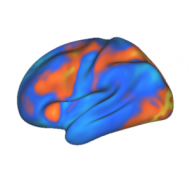
What brain regions are involved? A mountain of evidence is accumulating that a common set of brain regions are involved in cognitive control. We looked for these regions specifically, and verified that they were active during our experiment [see top figure]. The brain regions are spread across the cortex, from the front to the back to either side. However, it's not the whole brain: there are distinct parts that are involved in cognitive control and not other behavioral demands. (more…)

The role of reward and cognitive control in decision making

Monday, September 24th, 2007

Here's an exchange of emails between PL and MC on a recently published paper (Balleine et al., 2007).

Email 1 (from PL):
Have a look at this introductory paragraph from a recent (Aug 2007) J Neurosci article by Balleine, Delgado and Hikosaka. What do they mean by "cognition" here?

The Role of the Dorsal Striatum in Reward and Decision-Making
To choose appropriately between distinct courses of action requires the ability to integrate an estimate of the causal relationship between an action and its consequences, or outcome, with the value, or utility, of the outcome. Any attempt to base decision-making solely on cognition fails fully to determine action selection because any information, such as “action A leads to outcome O,” can be used both to perform A and to avoid performing A. It is interesting to note in this context that, although there is an extensive literature linking the cognitive control of executive functions specifically to the prefrontal cortex (Goldman-Rakic, 1995; Fuster, 2000), more recent studies suggest that these functions depend on reward-related circuitry linking prefrontal, premotor, and sensorimotor cortices with the striatum (Chang et al., 2002; Lauwereyns et al., 2002; Tanaka et al.,2006).


Email 2 (from MC):

 
It sounds like they are distinguishing cognition from reward processing. I'm not sure why, since 'cognition' typically encompasses reward processing now days.

The distinction I think they're really trying to make is between cognitive control and reward processing. Given that, it's still a ridiculous paragraph. Why must it be either cognitive control or reward processing? It's likely (no, virtually certain!) that the two interact during reward-based decision making. For instance, O'Reilly's stuff shows how this might happen.

Another problem with this paragraph: They equate causal knowledge with cognitive control. Well-known causal knowledge doesn't involve cognitive control! For instance, routine decision making would involve lower perceptuo-motor circuits, and if it involved differential reward then reward circuits would be engaged as well. Cognitive control has little/no role here.

When cognitive control is involved it's probably doing a lot more than just retrieving causal relations from semantic memory. For instance, perceptual decision making studies show that cognitive control is involved even in deciding what is being perceived when uncertainty arises.

I guess what they're trying to do is show that cognitive control doesn't explain all of decision making since there must be a reward component as well. Perhaps this is a good point to make; they just didn't do it well.


Email 3 (from PL):

Ahhh, ok I think I see now what they're trying to say.  It really just struck me as an excessively divisive statement to start out what appeared to be an interesting article.  Can you say "flamebait"?  Perhaps they're trying to be provocative.

- PL & MC