History’s Top Brain Computation Insights: Day 14
Sunday, April 15th, 2007
14) Neocortex is composed of columnar functional units (Mountcastle - 1957, Hubel & Wiesel - 1962)
Mountcastle found that nearby neurons in monkey somatosensory cortex tend to activate for similar sensory experiences. For example, a neuron might respond best to a vibration of the right index finger tip, while a neuron slightly deeper in might respond best to a vibration of the middle of that finger.
The neurons with these similar 'receptive fields' are organized vertically in cortical columns. Mountcastle distinguished between mini-columns, the basic functional unit of cortex, and hyper-columns, which are functional aggregates of about 100 mini-columns.
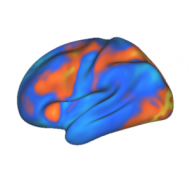
Hubel & Wiesel expanded Mountcastle's findings to visual cortex, discovering mini-columns showing line orientation selectivity and hyper-columns showing ocular dominance (i.e., receptive fields for one eye and not the other). The figure below illustrates a typical spatial organization of orientation columns in occipital cortex (viewed from above), along with the line orientations corresponding to each color patch.
Implication: The mind, largely governed by reward-seeking behavior, is implemented in an electro-chemical organ with distributed and modular function consisting of excitatory and inhibitory neurons communicating via ion-induced action potentials over convergent and divergent synaptic connections strengthened by correlated activity. The cortex, a part of that organ composed of functional column units whose spatial dedication determines representational resolution, is involved in perception (e.g., touch: parietal lobe, vision: occipital lobe), action (e.g., frontal lobe), and memory (e.g., temporal lobe).
[This post is part of a series chronicling history's top brain computation insights (see the first of the series for a detailed description). See the history category archive to see all of the entries.]
-MC


12) Hippocampus is necessary for episodic memory formation (Milner - 1953)
11) Action potentials, the electrical events underlying brain communication, are governed by ion concentrations and voltage differences mediated by ion channels (Hodgkin & Huxley - 1952)
9) Convergence and divergence between layers of neural units can perform abstract computations (Pitts & McCulloch - 1947)
8) Reward-based reinforcement learning can explain much of behavior (Skinner - 1938, Thorndike - 1911, Pavlov - 1905)


Backpropogation of Error (or "backprop") is the most commonly-used neural network training algorithm. Although fundamentally different from the less common Hebbian-like mechanism mentioned in 
3) Functions are distributed in the brain (Flourens - 1824, Lashley - 1929)
This post is part of a series chronicling history's top brain computation insights (see
It is hard to maintain historical perspective as neuroscience progresses. Today's complications and confusions seem to cloud the clear insights of the past. This is inevitable when trying to understand the brain, the most complex computational device known.